Agwasuri
A solar-powered IoT and machine-learning system that monitors water quality in real time and recommends suitable aquaculture species for fishpond operators in San Juan I, Ternate, Cavite.
Automation & AI · 2026 · Municipal Agricultural Office of Ternate
Implementation
I designed the web UI in Figma and built the frontend using Tailwind CSS and JavaScript. I modeled the 3D hardware casing in Blender and fabricated it using fiberglass cloth, polyester resin, and MEKP catalyst. I also interviewed fishpond owners and the Municipal Agriculture Office of Ternate, tested the system in actual fishponds, and coordinated our team's case study tasks.
Context & stakes
Fishpond operators in San Juan I, Ternate relied on trial-and-error species selection and manual water checks. Summer salinity spikes and rainy-season freshwater dilution caused mass fish kills within 2 to 3 days of stocking, wiping out capital and family income.
A single cycle represents months of savings: fingerlings, feed, labor, and pond preparation. With only two to three cycles per year, one bad season can erase a year's household income.
“Wala kaming ginagamit na device... sana meron para mas accurate.”
“We don't use any device... I wish there was one so it's more accurate.”
“Pag alpas mo pa lang, kuha na siya agad, mga dalawa o tatlong araw lang, namamatay na.”
“Right after stocking, it's gone almost immediately. Two or three days, then they're dead.”
“Gastos ka na ng pera, kailangan mong kumita para sa pamilya.”
“You've already spent money, and you need to earn for your family.”
Solution & approach
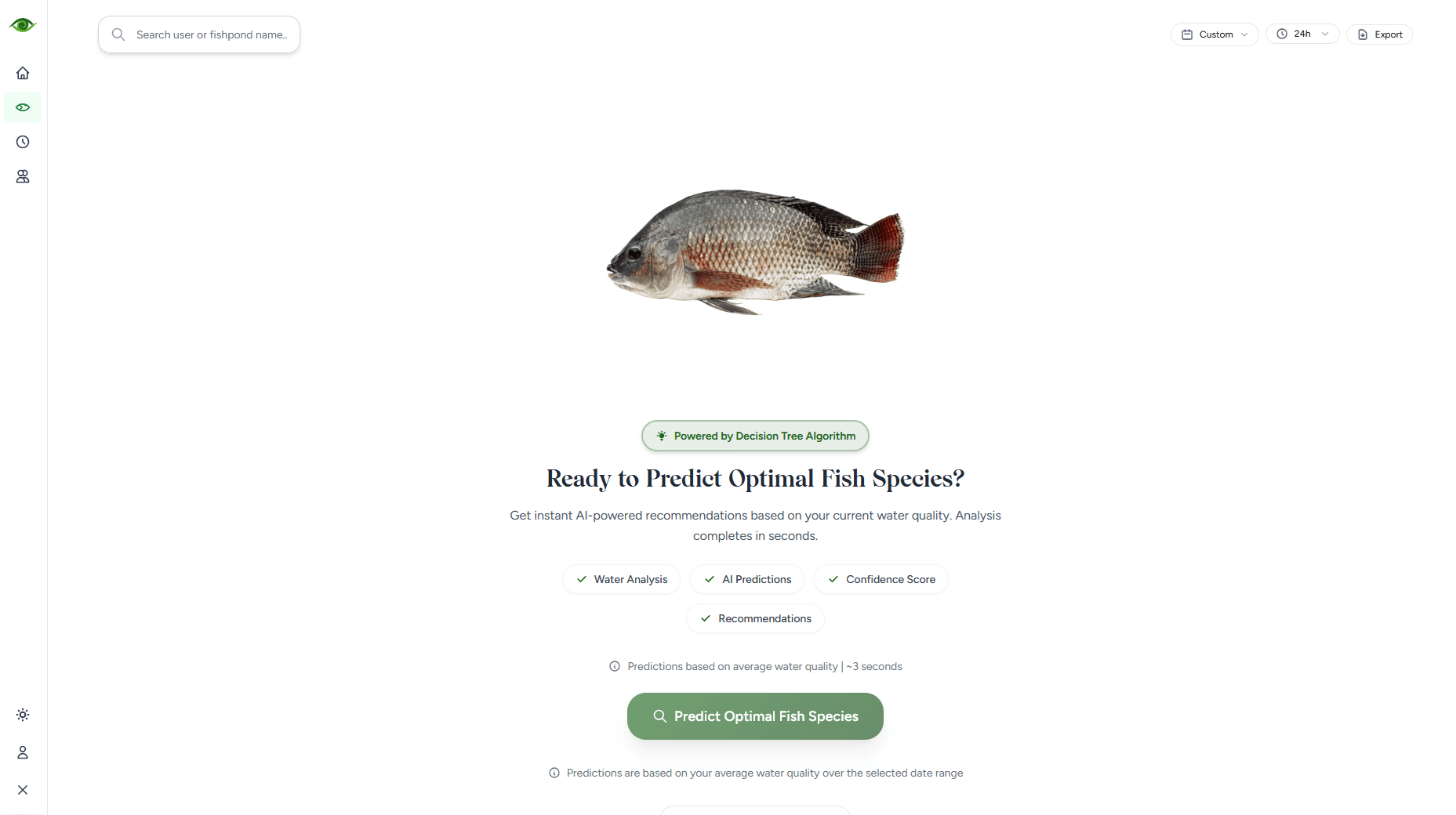
A solar-powered floating device monitors pond conditions continuously. The dashboard shows live readings and historical trends, and the Machine Learning (ML) model recommends which species will thrive based on current water quality.
Live dashboard
The dashboard refreshes in real time as new sensor data arrives. Operators see current pond conditions, historical trends, and the recommended species without refreshing the page.
Hardware & Sensors
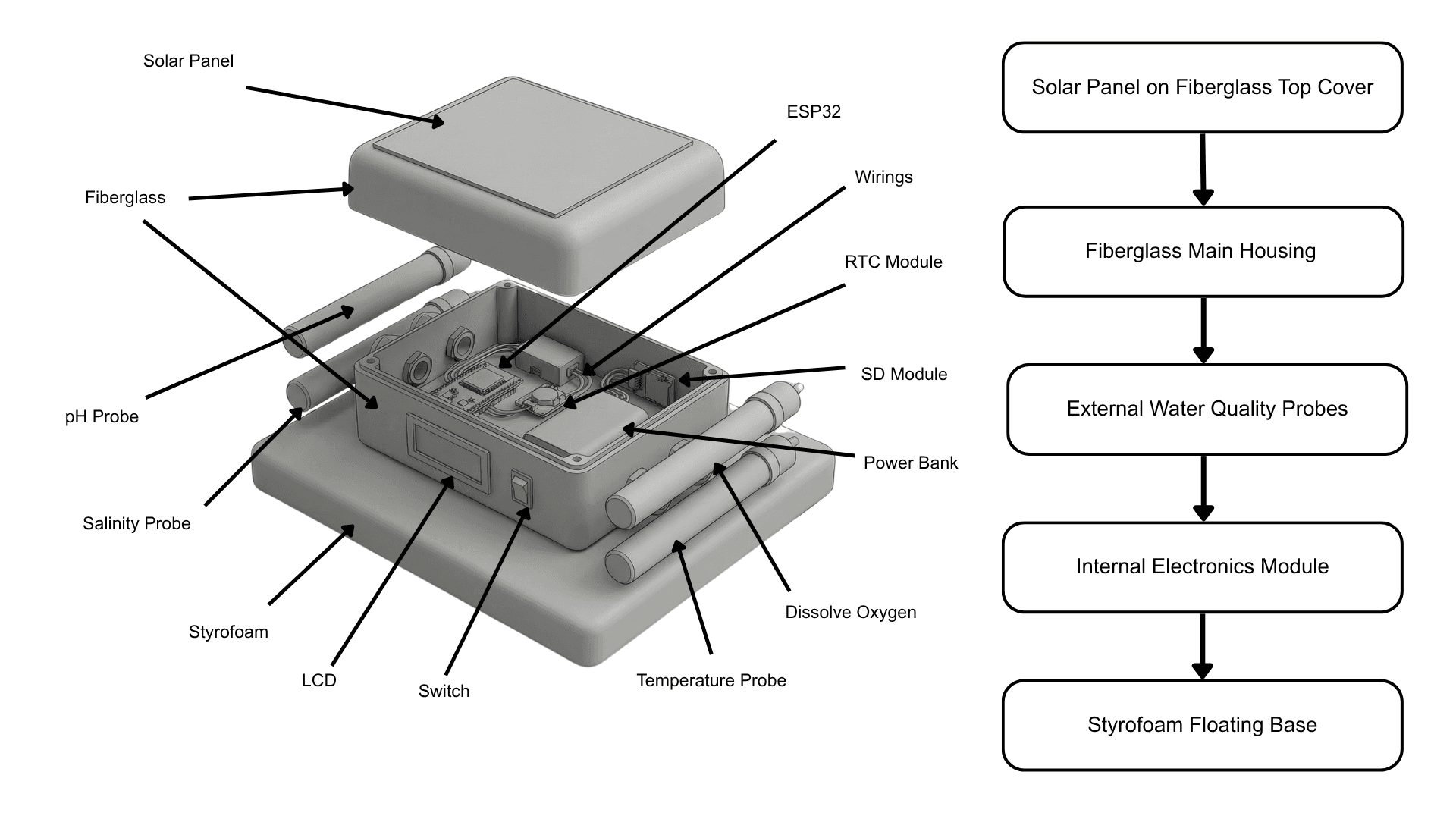
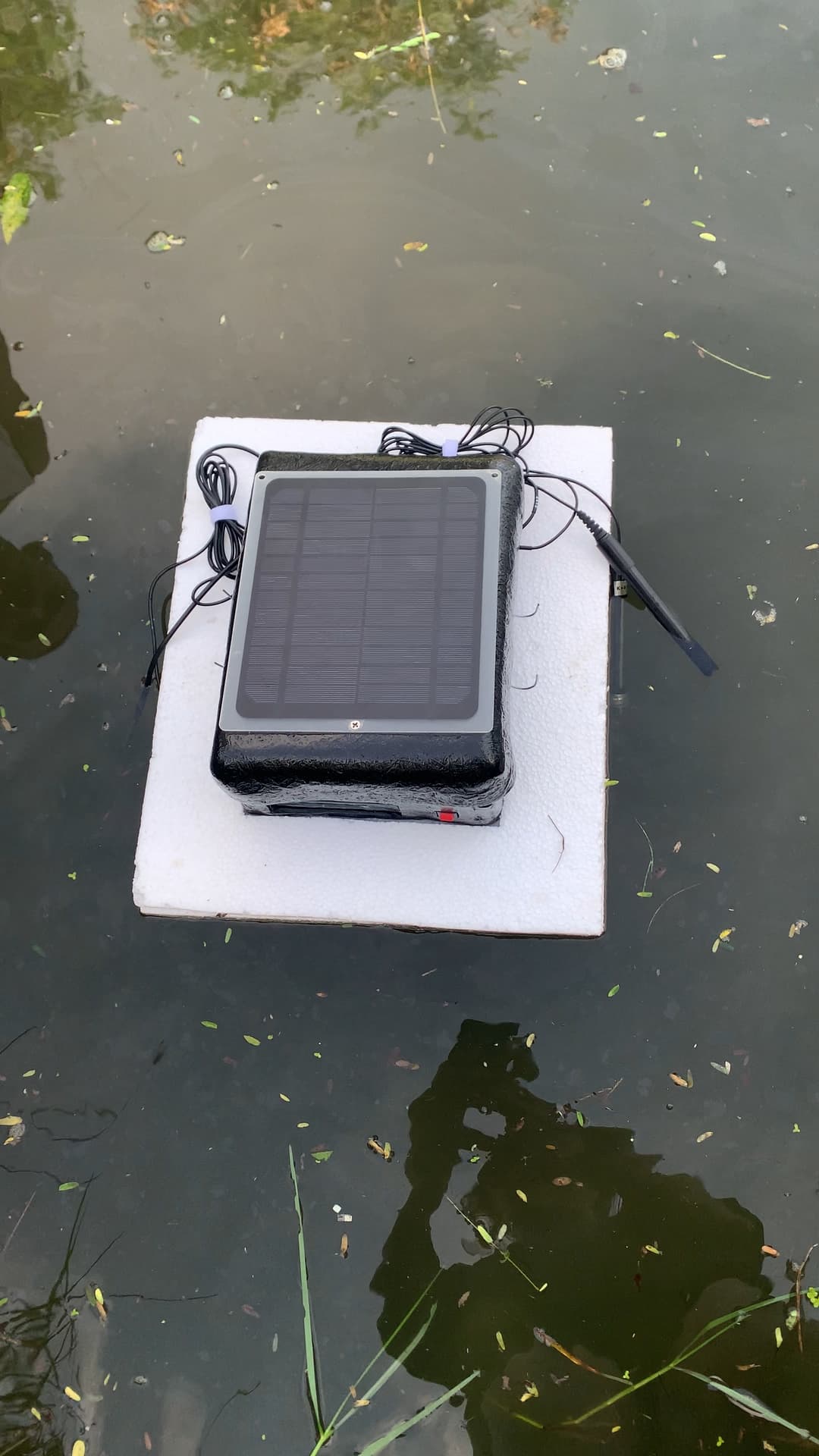
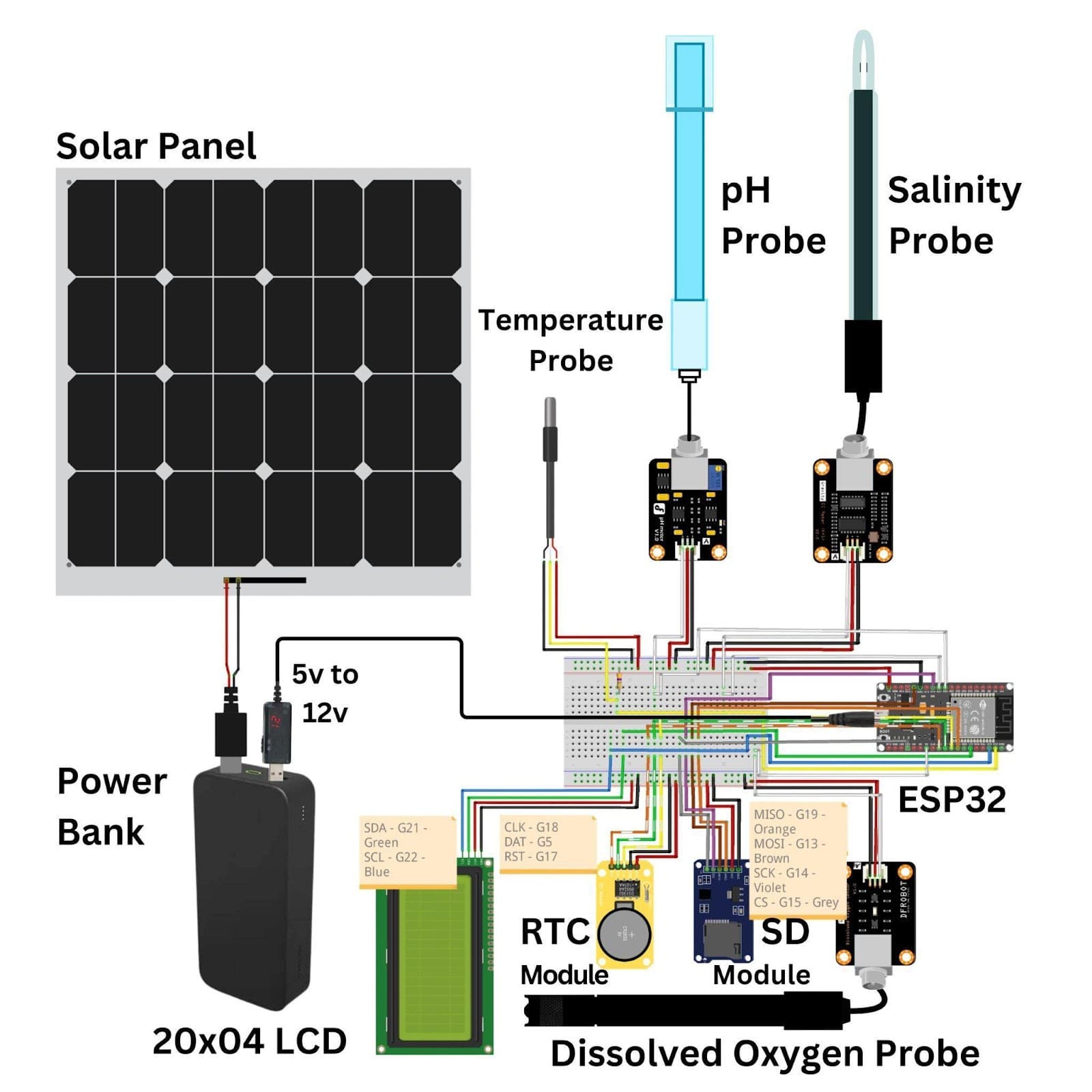
Everything runs on a 12V solar panel with a 20,000 mAh battery. When Wi-Fi drops, readings log to microSD and sync later. The device floats on a fiberglass enclosure with styrofoam base.
| Sensor | Measures | Model |
|---|---|---|
| pH | Water acidity/alkalinity | pH-4502C |
| Dissolved Oxygen | Oxygen available for fish | Galvanic Probe |
| Salinity / EC | Salt concentration | DFRobot Gravity |
| Temperature | Water heat | DS18B20 |
Decision Tree Model
The Decision Tree reads four inputs and outputs the best species:

| Algorithm | Accuracy | Train | Predict |
|---|---|---|---|
| Decision Tree | 93.5% | 0.018s | 0.001s |
| Random Forest | 93.5% | 0.929s | 0.014s |
Same accuracy as Random Forest, but 51x faster to train and 14x faster to predict. That speed makes it edge-deployable and easy for operators to understand, since every recommendation traces back to clear rules. Benchmarked against SEAFDEC optimal parameter ranges for each of the five species.
System design overview
- SensorspH · DO · EC · Temp
- ESP32MicroPythonmicroSD · Offline logWi-Fi
- Laravel APIPHP · ReverbMySQL · Data storeReverb WS
- DashboardLivewire
- FastAPIDecision Tree
- SpeciesRecommendation
Physical Tiers
Solar-powered floating platform: ESP32-WROOM-32 (MicroPython) reads pH-4502C, Galvanic DO, DFRobot EC, and DS18B20 sensors, with offline microSD logging that syncs automatically on reconnect. Fiberglass buoy enclosure, 20,000 mAh LiFePO4 battery, and a 12V solar panel keep it running off-grid.
Software Tiers
A Laravel 11 API with a Reverb WebSocket pipeline ingests sensor data into MySQL and streams it to the Livewire dashboard. FastAPI hosts the Decision Tree classifier (scikit-learn), benchmarked against SEAFDEC optimal parameters. Decision Tree was chosen over Random Forest for 0.001s edge-deployable inference.
Measurable outcomes
Ten participants from four groups (fishpond operators, MAO officers, marine science experts, IT experts) rated Agwasuri Excellent across the board. The Decision Tree model matched Random Forest accuracy at a fraction of the compute cost.
| Metric | Score |
|---|---|
| Decision Tree Accuracy | 93.5% |
| Training Time | 0.018s |
| Prediction Time | 0.001s |
| Software Evaluation (ISO/IEC 25010) | 4.84 / 5.00 (Excellent) |
| Hardware Usability (SUS) | 4.85 / 5.00 |
People behind the project
Researchers: Jazrel Dennis P. Mendoza · Reymar V. Mirante · John Mark A. Pachico
Adviser: Dr. Ricky Jay A. Riel
Technical Critic: Dr. Rossian V. Perea
Institution: Cavite State University Naic, January 2026
My Role: IoT System Design, Embedded Firmware, Machine Learning, Full-Stack Web Development, UI/UX Design, 3D Modeling & Hardware Fabrication, Field Research & Interviews
Technologies used
- Hardware & sensors
- pH-4502CGalvanic DO sensorDFRobot EC sensorDS18B20
- Embedded
- ESP32-WROOM-32MicroPython
- Backend & data
- Laravel (PHP)MySQLFastAPI
- Machine learning
- Decision Tree Classifierscikit-learnjoblib
- Web frontend
- Tailwind CSSJavaScript
- Design & prototyping
- FigmaFritzingBlender